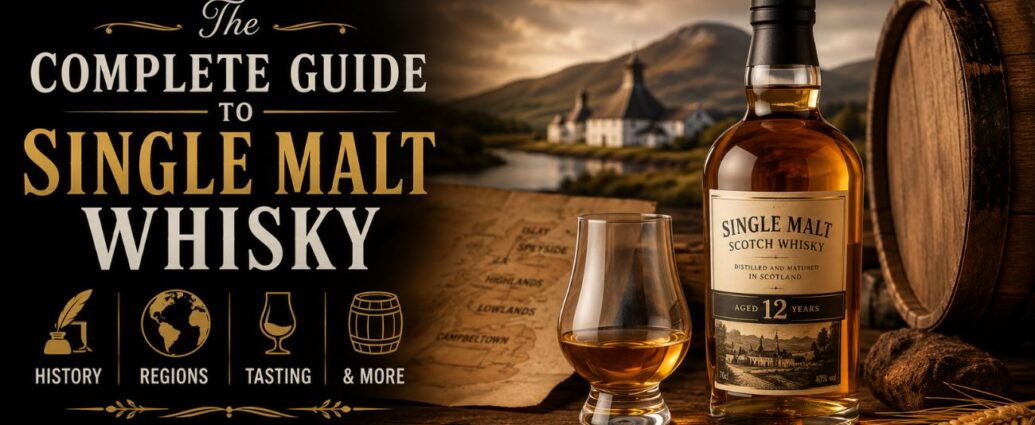
Single malt whisky is a spirit few other types command with as much reverence, curiosity and dogged following. Whether you’re an old salt or just picked up your first bottle, exploring single malt whisky is the entry point to one of mankind’s most complex and long-standing drinking traditions. Ranging from the cloudy highlands of Scotland to the undulating hills of Japan, aged single malt whisky has set up an eternal place in the culture of normal spirits and for legitimate reason.
This guide will teach you everything you need to know about single malt whisky: what it is, its history, how it’s made and where you can find regional differences, a tastinghow-to and tips on how to pick the perfect bottle for your palate.
What Is Single Malt Whisky?
Single malt whisky is a whisky that has:
- Of 100% malted barley as the grain source
- Distilled at one distillery (single = not from a single barrel).
- Distilled in pot stills
- Aged in oak casks for a minimum (usually three years in Scotland)
We ought to clear one thing up, and that’s the common misconception that “single” means one cask / + one batch whisky. Single malt whisky may be a blend of multiple casks from the same distillery, created to deliver one consistent house style. So long as it is made at a single distillery from a single grain, that’s the defining characteristic.
Single malt whisky is different from blended whisky, the latter of which combines malts and grain whiskies across numerous distilleries. Nor is it the same as blended malt (or sometimes called vatted malt), which combines malts from different distilleries but does not contain any grain whisky at all.
A Brief History of Single Malt Whisky
A single malt whisky is defined by a long story that goes back centuries. The knowledge of distillation is thought to have reached Scotland and Ireland from monastic scholars in circa 11th or 12 century. The first documented reference to Scotch whisky goes back more than 600 years, with the Scottish Exchequer Roll of 1494 recording a purchase of malt by a friar for producing “aqua vitae” — or “water of life”.
Single malt whisky was tasted close-to-home and made illegally for much of its early existence. Spirits were nakedly taxed and illicit distilling ran wild in the Scottish Highlands, with innumerable hidden stills tucked into glens and caves. The Excise Act of 1823 ultimately opened the door for affordable and practical legal distilling, entering into the era of contemporary age Scotch whisky production.
Blended Scotch took control around the world in the late 1800s and held it for much of the next century, vanquishing single malts to obscurity. Only in the 1960s and 1970s did pioneers like Glenfiddich engage in direct-to-consumer marketing of single malt whisky, setting off a revolution that is still underway.
Not only has Japanese whisky become a huge global phenomenon since its introduction of single malt but today single malt whisky is produced in Scotland, Ireland, Japan, the United States, India,Taiwan and dozens of other countries around the world.
How Single Malt Whisky Is Made
Single malt whisky is made from barley, but the process that takes this humble grain and turns it into liquid gold is tightly controlled.
Step 1: Malting
Grains start from being soaked in water until they germinate, and then dried with the help of a kiln. If burned during the kilning process, it gives that smoky quality so treasured in several single malt whisky offerings.
Step 2: Mashing
The dried, malted barley (which would now be referred to as “malt”) is crushed into a coarse flour called grist. Which extracts fermentable sugars to hot water creating a sweet liquid by the name of “wort”.
Step 3: Fermentation
The wort is then placed in large vat-like vessels called washbacks, where yeast is added and sugars fermented into alcohol for 48–96 hours. This forms a beer-like liquid known as “wash” at around 8 percent ABV.
Step 4: Distillation
It is the single malt whisky that must be distilled in copper pot still. While most distilleries will distill twice (three at times) and progressively concentiate the alcohol, refining the spirit each time. The distiller only matures the “heart” cut of the distillate.
Step 5: Maturation
Oak casks (most often ex-bourbon barrels or ex-sherry butts) are then filled with new spirit and allowed to mature. The single malt whisky extracts a lot of color, flavor and complexity from the wood during this phase but simultaneously is losing harsh immature notes. The legal minimum maturation in Scotland is three years, most premium expressions mature for 10, 12, 18 or even 25+ years.
The Major Single Malt Whisky Regions of Scotland
While Scotland may well be the home of single malt whisky, each featured area produces unique and distinctive styles that combine to create five main regions.
| Region | Flavor Profile | Notable Distilleries |
| Speyside | Fruity, floral, elegant, gentle sweetness | Glenfiddich, Macallan, Glenlivet, Balvenie |
| Highland | Diverse: heathery, honeyed, spicy, full-bodied | Dalmore, Glenmorangie, Oban, Blair Athol |
| Islay | Peaty, smoky, maritime, medicinal | Laphroaig, Ardbeg, Bowmore, Bruichladdich |
| Lowland | Light, grassy, gentle, approachable | Auchentoshan, Glenkinchie, Bladnoch |
| Campbeltown | Briny, oily, complex, slightly smoky | Springbank, Glen Scotia, Glengyle |
The single malt whisky from each region represents its geography, water source and customs. With Atlantic winds and peat bogs, Islay malts tend to be heavy while the sheltered valleys of Speyside yield lighter, floral expressions that come up soft from spring water.
World Single Malt Whiskies Beyond Scotland
The single malt whisky category has gone global. Lets take a snapshot of some of the key producing countries.
| Country | Key Characteristics | Noted Producers |
| Ireland | Triple-distilled, smooth, light, approachable | Bushmills, Teeling, Waterford |
| Japan | Precise, elegant, floral, subtle complexity | Yamazaki, Hakushu, Nikka Yoichi |
| USA | Rich, bold, often bourbon-cask influenced | Westland, Stranahan’s, Balcones |
| India | Tropical maturation, rich, fruity, fast-aged | Amrut, Paul John, Rampur |
| Taiwan | Sweet, fruity, lush, humid-climate notes | Kavalan |
Japanese single malt whisky particularly has taken over the world. Bringin the word there are distilleries, judging from multi-global awards like Yamazaki and Hakushu proving that not all greatest single malt whisky is only Scottish born.
How to Taste Single Malt Whisky Like a Pro
To truly appreciate single malt whisky, you must engage all your senses. Follow these steps:
1. Choose the Right Glass
A tulip glass (which includes a Glencairn) is the standard preferred by experts for nosing straight single malt whisky due to its shape and how it concentrates aromas.
2. Observe the Color
Hold the glass up to light. The hue of a single malt whisky — ranging from pale gold through dark mahogany — indicates its cask type and age.
3. Nose the Whisky
Gently swirl, then bring the glass to your nose before tasting it. Breathe in slowly. On the palate, one will find fruit like banana and apple, vanilla and spice from the cask, followed by floral notes with oak, smoke or sea salt in a good single malt whisky.
4. Taste
Now take a little sip of it, and allow the flavor to coat your palate. Look for the arrival (first impact), evolution (flavor development), and finish (how long they linger). Single malt whisky of a fine quality can have a finish that can last minutes.
5. Add a Drop of Water (Optional)
Adding uncarbonated water three drops (and emulsifiers in the science arena) to a single malt whisky “opens up” it by releasing more aromatic compounds and softening the alcohol.
Single Malt Whisky Age Statements: What They Mean
| Age Statement | What to Expect |
| No Age Statement (NAS) | Blended from casks of varying ages; can be excellent value |
| 10–12 Years | Accessible, fresh, lively; classic entry-level expressions |
| 15–18 Years | Greater complexity, depth, and wood influence |
| 21–25 Years | Rich, nuanced; significant cask contribution |
| 30+ Years | Extremely rare; profound complexity; collector territory |
Age is not everything in single malt whisky. Just a good no age statement, from a great distillery, will beat an older whisky in a mediocre one.
Food Pairing with Single Malt Whisky
It’s an area many whisky lovers fail to explore, yet single malt whisky can be a stunning food pairing.
| Style of Single Malt Whisky | Ideal Food Pairing |
| Light, Floral (Speyside) | Sushi, smoked salmon, mild cheeses |
| Fruity, Sherried | Dark chocolate, Christmas pudding, aged cheddar |
| Smoky, Peaty (Islay) | Oysters, smoked meats, blue cheese |
| Light, Grassy (Lowland) | Cucumber sandwiches, soft goat cheese, sashimi |
| Rich, Oily (Campbeltown) | Charcuterie, strong cheddar, roasted nuts |
Collecting and Investing in Single Malt Whisky
Single malt whisky has become an authentic asset class in its own right over the last few decades. Things like single malt whisky from distilleries such as Macallan, Springbank and Port Ellen in rare bottles when sold at auction can sell out for tens of thousands — or even hundreds of thousands — of dollars.
The following factors make single malt whisky a more valuable collectible: Age Distillery output Limited release Closed distilleries (irreplaceable bottles) Original packaging condition
If you are exploring the idea of collecting single malt whisky, always keep them bottles upright (to remain cork-proof), away from direct light and extreme temperature spikes/hill tops.
Frequently Asked Questions About Single Malt Whisky
What is the difference between single malt whisky and blended Scotch?
Single malt whisky is whisky made at one distillery using only malted barley. Blended Scotch blends malt whisky from at least two distilleries with grain whisky, producing a more uniform but ultimately less characterful product. Single malts generally provide more depth and character.
Does “single malt” mean it comes from one barrel?
No. One of the biggest single malt whisky misconceptions. Note that single means a single distillery of origin, not a single cask. Single malt whisky is vatted from multiple casks to give it a same flavour profile but most of the bottlings. The term “single cask” expression is specifically marked.
Is older single malt whisky always better?
Not necessarily. Age naturally adds complexity to single malt whisky, but it can also be a double-edged sword — over-aged whiskies are often overwhelmed by wood tannins and lose their fruit and spirit character. Sometimes, a good 12-year-old single malt whisky can make for an even more pleasant drink than a poorly stored 25-year-old expression.
Should I add ice to single malt whisky?
In the case of fine single malt whisky, a general rule is to avoid ice altogether, as it lowers the temperature too quickly and numbs the palate — subduing colours and aromas essential to quality. A whisky stone (for chilling without melting) is ideal for a less-taste-sensitive imbiber who leans more toward bubbly drinks. A dash of still water, though, is now largely accepted amongst single malt aficionados.
What is peated single malt whisky?
Peated single malt whisky uses malt that has been dried over burning peat (a decomposed organic material found in Scottish bogs). The barley absorbs phenolic compounds from the peat smoke, imparting smoky, medicinal or earthy notes to the final single malt whisky. Islay is known for its heavily peated single malt whisky expressions.
How should I store an opened bottle of single malt whisky?
Single malt whisky can last for years, stored properly, once opened. Keep tightly sealed in an upright position, dark place and at room temperature. When the level falls and the air enters the bottle, oxidation slowly modifies the profile of whisky de malt ungi; this may enhance it for some, while others may prefer to finish their bottle within a year after uncorking it.
Conclusion
Single malt whisky is much more than a beverage; it is an active tie to generations of skill, land and heritage. No matter if you are prone to the floral and gentle finesse of a Speyside single malt whisky, the maritime smoke of an Islay expression, or the tropical fruitiness surrounding an Indian single malt whisky… there is an experience to be explored with each pour.
No journey is more rewarding for a spirit lover than the exploration of single malt whisky. Begin with a well known classic, move around for different areas and styles, and above all have an inquisitive palate as you drink! Nations rich in single malt whisky are dishing up a world for those willing to slow down, notice, and enjoy each dram.


Comments are closed, but trackbacks and pingbacks are open.